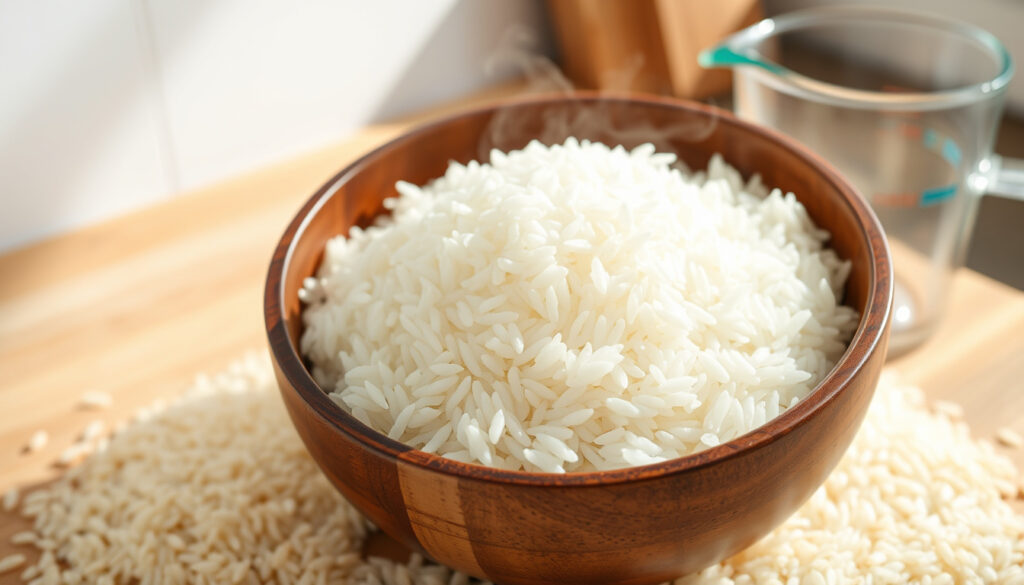
Jasmine Rice: Differences, Health Benefits, and How to Cook It
Few pantry staples spark as much debate as rice — and jasmine rice, with its floral aroma and tender texture, often sits at the center of the conversation. Its signature scent comes from a compound called 2-acetyl-1-pyrroline, the same molecule that gives pandan leaves their fragrance. This guide breaks down the science behind jasmine rice, how it stacks up against white and basmati varieties, and the best way to cook it.
Grain Type: Long-grain ·
Aroma Compound: 2-acetyl-1-pyrroline ·
Calories per cup (cooked): ~180 ·
Glycemic Index: 68–80 ·
Primary Origin: Thailand
Quick snapshot
- Jasmine rice is an aromatic long-grain variety (Nutrition Value (food database))
- Standard cooking ratio is 2 cups water to 1 cup rice, simmered 15–18 minutes (USA Rice Federation (industry authority))
- Calorie content ranges from 129 to 205 per cooked cup depending on brand and serving size (Princeton University Dining (university food service), Recipal (nutrition aggregator))
- Jasmine rice is naturally gluten-free (Zafaran Rice (brand site))
- Exact glycemic index varies by brand and cooking method — reported range is 68–80 (Nutrition Value)
- Whether jasmine rice is “healthier” than other white rices depends on dietary context, not a single metric (Princeton University Dining)
- Nutrition labels vary significantly between brands, making direct comparisons misleading (Recipal)
- Cooking time for jasmine rice is consistently 15–18 minutes, per USA Rice guidelines (USA Rice Federation)
- Resting the rice for 5 minutes after cooking is a recommended step to improve texture (Cook Smarts (cooking education site))
- As demand for aromatic rice grows, more brands are offering brown and organic jasmine rice (Princeton University Dining (brown basmati label))
- Standardized nutrition labeling would help consumers make informed choices (Princeton University Dining)
Six key facts, one pattern: jasmine rice is nutritionally similar to other white rices but its aroma and cooking properties set it apart.
| Label | Value |
|---|---|
| Type | Long-grain white rice |
| Aroma | Pandan-like (2-acetyl-1-pyrroline) |
| Calories per cup (cooked) | ~180 kcal |
| Glycemic index | 68–80 |
| Fiber per cup | <1 g |
| Gluten-free | Yes |
The trade-off: jasmine rice offers a distinctive sensory experience but lacks the fiber and lower GI of whole-grain alternatives.
How is jasmine rice different from regular rice?
Appearance and texture
- Jasmine rice is a long-grain variety, though it is slightly shorter and plumper than basmati (Nutrition Value (food database)).
- When cooked, jasmine rice clumps together more than standard long-grain white rice, giving it a slightly sticky texture (USA Rice Federation).
Aroma and flavor
- The characteristic scent comes from 2-acetyl-1-pyrroline, a compound also found in pandan leaves (Wikipedia (encyclopedia)).
- Regular white rice lacks this compound and has a mild, neutral aroma.
Cooking properties
- Jasmine rice absorbs water at a 2:1 ratio and cooks in 15–18 minutes (USA Rice Federation).
- Standard white rice often uses a similar ratio but may require slightly longer cooking times (The Mom 100 (food blog)).
The implication: jasmine rice is not just “white rice with perfume” — its grain structure and cooking behavior differ in ways that matter for texture and recipe outcomes.
How do you cook jasmine rice?
Water-to-rice ratio
Use 2 cups of water for every 1 cup of jasmine rice, according to the USA Rice Federation (industry authority). Some cooks prefer a tighter 1.5:1 ratio for less sticky results, but the standard gives consistent fluffiness.
Rinsing technique
Rinse the rice in a fine-mesh sieve under cold water until the water runs clear. This removes excess surface starch and prevents the grains from becoming gummy (Cook Smarts (cooking education site)).
Cooking methods (stovetop, rice cooker, Instant Pot)
- Stovetop: Bring water and rice to a boil, reduce heat to low, cover, and simmer for 15–18 minutes. Remove from heat and let rest 5 minutes before fluffing (USA Rice Federation).
- Rice cooker: Use the same 2:1 ratio. Most rice cookers have a white rice setting that works well for jasmine rice.
- Instant Pot: Use 1:1 water-to-rice ratio and cook on high pressure for 4 minutes, then natural release for 10 minutes.
Resting and fluffing
After cooking, let the rice sit covered for 5 minutes. This allows the steam to redistribute and the grains to firm up. Fluff with a fork, not a spoon, to separate the grains without breaking them (Cook Smarts).
Home cooks who master the 2:1 ratio and the resting step consistently get fluffy, aromatic jasmine rice. Skipping the rinse or the rest leads to a gummy, clumpy result.
The pattern: jasmine rice rewards patience — a few extra minutes of resting and a gentle fluff make the difference between a side dish and a star.
What is better, jasmine or basmati rice?
Flavor profile
- Jasmine rice has a sweet, floral aroma reminiscent of pandan or popcorn (Wikipedia).
- Basmati rice offers a nutty, earthy fragrance, often described as “popcorn-like” but more subtle (Zafaran Rice (brand site)).
Texture differences
- Basmati grains remain separate and distinct after cooking, making it ideal for pilafs and biryani.
- Jasmine rice clumps slightly, which suits Thai curries and stir-fries where the rice needs to hold sauce.
Best culinary uses
- Basmati is the go-to for Indian and Middle Eastern dishes.
- Jasmine rice is the staple in Southeast Asian cuisine, especially Thai, Vietnamese, and Lao cooking.
Nutritional comparison
One comparison, three rices — here’s how they stack up per cooked serving.
| Nutrient | Jasmine (white) | Basmati (white) | Basmati (brown) |
|---|---|---|---|
| Calories | ~180 / cup | ~216 / 195 g | ~137 / 4 oz |
| Carbohydrates | ~39 g / 140 g | ~48 g / 195 g | ~26.6 g / 4 oz |
| Fiber | <1 g | <1 g | 2.4 g |
| Glycemic Index | 68–80 | 50–58 | 50–55 |
| Fat | 0.2 g | 0.5 g | 0.6 g |
| Protein | 4 g / 140 g | 4.4 g / 195 g | 3.1 g / 4 oz |
The catch: basmati has a lower glycemic index and brown basmati packs more fiber, but jasmine’s flavor and texture are irreplaceable for certain dishes.
Is jasmine rice healthier than white rice?
Calorie and carbohydrate content
Both jasmine and standard white rice hover around 180–200 calories per cooked cup, with similar carbohydrate loads (Nutrition Value, Princeton University Dining).
Glycemic index comparison
Jasmine rice has a higher glycemic index (68–80) than standard long-grain white rice (about 64) and basmati (50–58). This means it can raise blood sugar more quickly (Nutrition Value).
Nutrient density
Enriched white rice products often add B vitamins and iron, but the amounts are small. Brown jasmine rice retains the bran and germ, offering more fiber, magnesium, and B vitamins (Princeton University Dining (brown basmati label)).
Impact on blood sugar
For people with diabetes or prediabetes, jasmine rice’s higher GI is a concern. Pairing it with protein, fiber, and healthy fats can blunt the glycemic response (Nutrition Value).
Jasmine rice is often marketed as a premium product, but from a health perspective it sits in the same category as plain white rice — not harmful, but not a nutritional upgrade. The real health gap is between white and brown rice, not between jasmine and other white varieties.
Why this matters: consumers who swap jasmine for white rice thinking it’s healthier are making a trade-off on flavor, not nutrition.
Which is the healthiest rice to eat?
Brown rice
Brown rice retains the bran and germ, providing fiber, magnesium, and B vitamins. It has a lower glycemic index (around 50) and supports digestive health (Princeton University Dining).
Wild rice
Wild rice is technically a grass seed, not a grain. It’s higher in protein (up to 15% by weight) and antioxidants than any white rice variety.
Black rice
Black rice is rich in anthocyanins, the same antioxidants found in blueberries and blackberries. It also contains more fiber than white rice.
White rice varieties (including jasmine)
All white rice varieties — jasmine, basmati, long-grain, short-grain — are stripped of the bran and germ, removing most of the fiber and nutrients. They are similar in calories and carbohydrate content.
Practical recommendations
- For maximum fiber and nutrients, choose brown, wild, or black rice.
- If you prefer white rice, basmati has a lower GI than jasmine or standard white rice.
- Jasmine rice is fine in moderation, especially when paired with vegetables and lean protein.
The trade-off: the healthiest rice is the one you eat with a balanced diet — but whole-grain options clearly outperform white varieties in micronutrient density and glycemic control.
Pros and cons of jasmine rice
Upsides
- Distinctive floral aroma and flavor
- Pleasant slightly sticky texture for Asian dishes
- Naturally gluten-free
- Quick cooking time (15–18 minutes)
- Widely available and affordable
Downsides
- Higher glycemic index than other white rices
- Low fiber content (<1 g per serving)
- Less nutrient-dense than brown or wild rice
- Can be clumpy if not rinsed properly
- Nutrition labels vary by brand, making health comparisons tricky
The balance: jasmine rice wins on aroma and cultural appeal but loses on nutrition when stacked against whole-grain alternatives.
Step-by-step guide to cooking perfect jasmine rice
- Rinse 1 cup of jasmine rice in a fine-mesh sieve under cold water until the water runs clear.
- Combine rice and 2 cups of water in a medium saucepan (USA Rice Federation).
- Bring to a boil over high heat, then reduce heat to low, cover, and simmer for 15–18 minutes.
- Remove from heat and let the rice rest, covered, for 5 minutes (Cook Smarts).
- Fluff with a fork to separate the grains.
What we know and what’s still uncertain
Confirmed facts
- Jasmine rice is an aromatic long-grain rice variety (Nutrition Value).
- Standard cooking ratio is 2:1 water to rice, 15–18 minutes (USA Rice Federation).
- Calories range from 129 to 205 per cooked cup (Princeton University Dining, Recipal).
- Jasmine rice is gluten-free (Zafaran Rice).
What remains unclear
- Exact glycemic index varies by brand and cooking method (68–80 range) (Nutrition Value).
- Whether jasmine rice is “healthier” than other white rices depends on dietary context (Princeton University Dining).
- Nutrition labels vary significantly between brands, making direct comparisons misleading (Recipal).
The pattern: the data supports jasmine rice’s role as a flavorful white rice, but the health halo around it is not backed by consistent evidence.
Expert perspectives on jasmine rice
Jasmine rice is a variety of long-grain rice that has a fragrant aroma similar to that of pandan leaves. The aroma is caused by the natural presence of 2-acetyl-1-pyrroline.
Combine 2 cups water with 1 cup rice, bring to a boil, then simmer covered for 15 to 18 minutes. Do not lift the lid during cooking.
– USA Rice Federation (industry authority)
Resting the rice with a towel under the lid helps absorb excess moisture and gives you perfectly fluffy rice every time.
– Cook Smarts (cooking education site)
The takeaway: from science to kitchen, jasmine rice is a well-studied ingredient with consistent cooking guidelines.
apps2.housing.k-state.edu, tools.myfooddata.com, reddit.com, tools.myfooddata.com
For a deeper dive into preparation techniques and nutritional details, see this complete cooking and nutrition guide on jasmine rice.
Frequently asked questions
Is jasmine rice gluten-free?
Yes, jasmine rice is naturally gluten-free, as it is made from rice, not wheat or other gluten-containing grains (Zafaran Rice).
What is the difference between white and brown jasmine rice?
White jasmine rice has the bran and germ removed, reducing fiber and nutrients. Brown jasmine rice retains the bran, providing more fiber, magnesium, and B vitamins. Brown also has a lower glycemic index.
Can diabetics eat jasmine rice?
Yes, in moderation. Because jasmine rice has a higher glycemic index (68–80), people with diabetes should pair it with protein, fiber, and healthy fats to slow glucose absorption (Nutrition Value).
How should I store jasmine rice?
Store uncooked jasmine rice in an airtight container in a cool, dry place. Cooked rice can be refrigerated for up to 4 days or frozen for up to 3 months.
Is jasmine rice the same as sticky rice?
No. Sticky rice (glutinous rice) is a different variety that becomes very sticky when cooked, while jasmine rice is only slightly clumpy. Sticky rice is used in desserts and dumplings.
What is the best jasmine rice brand?
Popular brands include Mahatma, Lundberg, and Dynasty. Look for “Thai Hom Mali” on the label for authentic Thai jasmine rice. Brand choice often depends on availability and price.
Can I cook jasmine rice in a rice cooker?
Yes. Use the same 2:1 water-to-rice ratio and select the white rice setting. The rice cooker will automatically switch to warm when done.
The bottom line: jasmine rice is a versatile, aromatic staple that cooks easily and fits many diets. Its nutritional profile is similar to other white rices, but the flavor and texture make it a unique choice for Asian-inspired meals. Cooks who understand the grain’s properties — its higher GI and lower fiber — can use it strategically within a balanced diet.
More related posts
 Luton Town v Coventry City: Hi tory, Rival , Key Fact
 Angela Merkel: Her Biography, Leadership, and Legacy
 Gel Nail Polish Banned – Truth on HEMA Restrictions
 Reggie Kray: East End Gangster’s Life and Tragic Love Story
 Brigitte Bardot Dies at 91: Life, Career and Controversies
 Ind vs SA Women – Head-to-Head Record and Next T20I
 Chris Eubank vs Conor Benn – Fight Results and Rivalry Conclusion
 Best Advent Calendars 2025: Ireland Buying Guide
