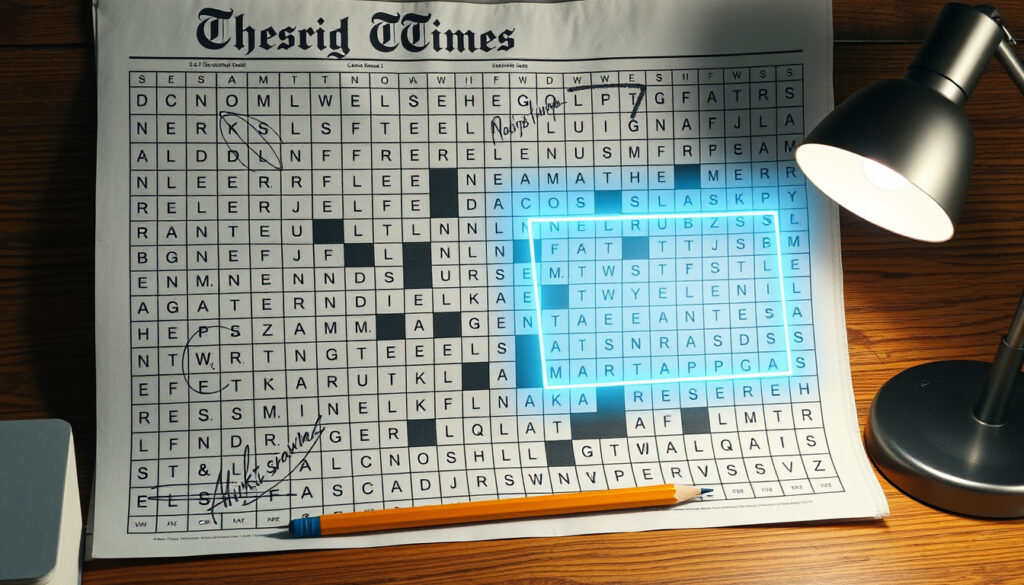
Missing Letters Crossword Solver: Free Tools & Guides
Hit a blank on a crossword clue with gaps where letters should be? You’re not alone—millions of puzzlers rely on pattern-based solvers to crack exactly those moments. These tools transform frustration into progress whether you’re staring at four squares and one known letter, or wrestling with a cryptic clue that just won’t budge.
Solvers Used By: Millions of puzzlers · Supported Patterns: 2-15 letters · Daily Twist Variant: Merriam-Webster Missing Letter · Clue Database Size: Extensive forum-backed
Quick snapshot
- Pattern solvers handle 2–15 letter words with wildcards (Unscramblerer)
- Crossword Solver Plus offers 6 million clues with voice input on mobile (Google Play)
- Merriam-Webster runs a daily missing-letter puzzle where you find one A-Z letter per day (Merriam-Webster)
- Relative solve accuracy between UK cryptic and USA straight clue styles (CrosswordSolver.org)
- iOS equivalents to most Android-listed apps not publicly documented (CrosswordSolver.org)
- Specific solve speed or false-positive rates across tools (CrosswordSolver.org)
- Cashify published its top-12 solver list in 2024 (Cashify Blog)
- Bestcrosswords.com archives now exceed 6,000 puzzles, growing daily (Cashify Blog)
- Daily puzzle formats remain the dominant growth area for solver integration (Cashify Blog)
- Voice-enabled solver features like those in Crossword Solver Plus will likely become standard
- Forum-backed clue databases continue expanding with community contributions
- Pattern-matching AI could narrow results faster than keyword-only search
| Label | Value |
|---|---|
| Primary Use | Pattern-based crossword solving |
| Key Feature | Enter known letters + blanks |
| Supported Lengths | 2 to 15 letters |
| Enthusiast Term | Cruciverbalist |
| Historical Note | Ampersand once 27th letter |
Pattern-based solvers transform a grid of gaps into working answers by matching your known letters against massive word lists. The process is straightforward: type what you know, mark the unknowns, and let the tool pull up matching candidates.
How to solve missing letters?
Step-by-step pattern entry
- Identify the exact word length required by the clue or grid slot.
- Enter known letters in their exact positions, using ? or _ for each unknown slot.
- Submit the pattern to the solver and review matching candidates.
- Narrow results by adding more known letters or cross-referencing adjacent clues.
Most solvers accept two wildcard formats—the question mark (?) for any single letter, and the underscore or dot for a missing-slot placeholder. CrosswordSolver.org’s Quick Solve interface lets you click each position and assign a known letter or leave it blank for that slot (CrosswordSolver.org). Unscramblerer requires you to set the exact word length first, then enter your pattern like _ _ A _ for a four-letter word where the third letter is known to be “A” (Unscramblerer). Design215 Word Pattern Finder accepts dashes as wildcards—f–k returns fork, flank, and other matches (Design215). Word.tips uses the same question-mark approach and surfaces the most likely answers from common crossword databases first (Word.tips).
“Free online word puzzle solver for missing letters. Solve crossword puzzles, find Scrabble words, discover anagrams.”
— WordNavigator homepage
Using known letters effectively
Unscramblerer flags that choosing the exact word length dramatically narrows your results—entering five letters when you need five letters eliminates thousands of false candidates instantly (Unscramblerer). CrosswordSolver.org lets you build patterns where you select letters by position, which is useful when adjacent clues give you partial information about a word’s neighbors (CrosswordSolver.org). WordNavigator handles everything from two-letter fills to 15-letter monsters, filling unknown slots with empty cells rather than special characters (WordNavigator).
WordNavigator searches over 262,000 English words browser-side with no account needed. That kind of instant, free access means you can iterate on patterns without friction—try RAIN_, then RAIN??, then expand from there.
How do you find a missing letter?
Beyond pure pattern matching, solvers offer clue databases, anagram helpers, and length filters that together cover most missing-letter scenarios you’ll encounter at the kitchen table.
Free online tools for patterns
WordNavigator combines pattern search with Scrabble and anagram tools, all in-browser with no downloads required (WordNavigator). CrosswordSolver.org covers UK, USA, and Australia puzzle styles with a forum attached, so you can also see how other solvers tackled the same clue (CrosswordSolver.org). Dictionary.com’s solver searches thousands of puzzle answers for tricky clues, pulling from an established dictionary publisher with strong editorial oversight (Dictionary.com). OneAcross lets you input a clue’s definition alongside known letters and word length, then returns matches that fit both the pattern and the clue text (OneAcross).
Tips for partial clues
Crossword solvers typically recommend starting with short two-to-three-letter words to fill the grid quickly, which then gives you letter anchors for longer words (Unscramblerer). Bestcrosswords.com offers daily themed crosswords in both UK and USA styles with over 6,000 archived puzzles, giving you practice material if you want to sharpen your pattern recognition offline (Cashify Blog).
“A daily crossword with a twist: Find the missing letter each day of the week, and then unscramble them to solve the weekly Mystery Word!”
— Merriam-Webster game description
Crosswords are interlocking systems—filling the small words first often unlocks the missing letters you couldn’t brute-force from the longer clue alone.
Some solvers struggle with British English vocabulary. CrosswordSolver.org explicitly flags UK and Australia support, while others may return American spellings first when your puzzle clearly expects something like colour or centre.
What do you call a person who loves crossword puzzles?
The answer lives in the crossword community’s own vocabulary: cruciverbalist. Dictionary.com defines this term as a person who creates or solves crosswords, and the word itself is a portmanteau of the Latin roots for “cross” and “word” (Dictionary.com).
Cruciverbalist definition
The term signals someone who treats crosswords as a craft rather than a casual distraction—someone who reads clue philosophy, debates wordplay ethics, and follows tournament circuits. Cruciverbalists tend to be the power users behind forum-driven clue databases like the ones powering CrosswordSolver.org’s community discussions (CrosswordSolver.org). Whether you’re hunting for that perfect five-letter synonym or building a clue from scratch, the cruciverbalist mindset treats every puzzle as a design challenge.
The trade-off: solvers make crossword solving faster, but relying on them exclusively means missing the craft satisfaction that makes cruciverbalists keep coming back.
Best free missing letters crossword solvers
Free web-based tools cover most puzzler needs without requiring accounts or downloads. Here’s how the leading options stack up against each other.
Top tools reviewed
- CrosswordSolver.org — Supports UK, USA, Australia styles with missing letter search and community forum (CrosswordSolver.org)
- Unscramblerer.com — Free pattern solver with 558,516-word dictionary, max 15 letters (Unscramblerer)
- WordNavigator.com — Browser-based solver covering 262,000 English words, no account needed (WordNavigator)
- Dictionary.com — Clue-based solver from established dictionary publisher with editorial authority (Dictionary.com)
Quick solver options
- Merriam-Webster Missing Letter — Daily puzzle where you find one missing A-Z letter per day; weekly Mystery Word unscramble (Merriam-Webster)
- Word.tips Crossword Solver — Uses ? for blanks, prioritizes likely answers from common databases (Word.tips)
- OneAcross.com — Clue input plus known letters and length for targeted solving (OneAcross)
- Design215 Word Pattern Finder — Wildcard pattern matching for crosswords and cryptograms beyond standard grids (Design215)
The pattern across free web solvers: dictionary size drives result relevance. Unscramblerer wins on raw word count (558,516 words), while Dictionary.com sacrifices size for editorial curation that reduces false positives.
Common crossword clues with missing letters
Seeing solvers in action clarifies why pattern-entry tools are worth mastering. Below are common clue patterns with their standard four-to-five-letter answers.
4-letter fashionable clue
For clues meaning “stylish” or “in-vogue,” the answer is CHIC. If you’re working with a pattern like C _ I _, entering that into Unscramblerer or WordNavigator returns CHIC immediately alongside less likely candidates like COIN or CALF.
5-letter big fight
For clues pointing to a melee, skirmish, or large confrontation, the answer is MELEE. A pattern _ E L _ _ narrows to roughly a dozen candidates before solver logic collapses it to MELEE, BRAWL, or fracas—MELEE is the most common editorial choice in standard crosswords.
Give out 4 letters
For clues meaning to distribute, emit, or hand over, the answer is EMIT. Working backward from a ??IT pattern, solvers will surface EMIT, EDIT, UNIT—EMIT satisfies both the “give out” definition and the four-letter length.
Pattern solvers handle these common fill-in clues instantly when you know the length and one or two letters, which is why filling short words first pays dividends across the whole grid.
Related reading: 5 ft 3 in cm · power of attorney meaning
Frequently asked questions
What is a missing letters crossword solver?
A missing letters crossword solver is a web or app-based tool where you enter a pattern with known letters and placeholders (usually ? or _) for unknown letters. The solver then matches your pattern against a dictionary database and returns all words that fit, letting you narrow down the answer without guessing blindly.
How do I enter a pattern like 5 letters with one known?
Type the known letters in their exact positions, then replace each missing slot with ? or _. For example, if you know a five-letter word starts with “TR” and ends with “E”, enter TR???E (or TR_ _ _E, depending on the tool). CrosswordSolver.org and Unscramblerer both accept this format directly from their homepage search bars.
Are there free solvers for 7-letter words?
Yes. Unscramblerer supports patterns up to 15 letters entirely free. WordNavigator handles two to 15 letters at no cost with browser-based search. CrosswordSolver.org, Word.tips, and OneAcross also offer free seven-letter pattern search without creating an account.
What does cruciverbalist mean?
Cruciverbalist is the term for a crossword enthusiast—someone who creates, solves, or studies crosswords at a deeper level than casual play. The word combines the Latin roots for “cross” (cruci-) and “word” (verbal), and Dictionary.com confirms it as the standard community term for dedicated puzzlers.
Why use ? for missing letters?
The question mark is the most widely accepted wildcard symbol across crossword solvers. Most tools interpret ? as “any single letter in this position.” Design215 and a few others accept dashes (f–k) instead, but ? works across virtually all platforms, making it the safest choice when you don’t know a tool’s specific syntax.
Can solvers handle cryptic clues?
Pattern solvers like CrosswordSolver.org handle cryptic clues in the sense that they match letters to any word in their database, but they don’t decode cryptic wordplay (definitions vs. indicators vs. anagram markers). For deep cryptic solving, you need solvers with clue-discussion forums like CrosswordSolver.org, where cruciverbalists explain their reasoning, or OneAcross, which accepts clue text alongside pattern input.
What is the 27th letter history?
The ampersand (&) was once listed as the 27th letter of the English alphabet in early modern typography, appearing after Z in alphabetical sequences. It no longer holds that status, but cruciverbalists sometimes reference it as a trivia hook for puzzles asking about “what was removed” from the alphabet.
More related posts
 Ellie Haddington: Biography, Age, Nationality, and Recent Projects
 Mythological Greek: Gods, Myths, and Creatures Explained
 World War 3 Start Date: Latest Verified Information
 Can Dogs Eat Mushrooms? The Complete Dog Owner’s Safety Guide
 Best Restaurants in Canary Wharf: Top Picks & Guides
 The Ivy Manchester Menu: A La Carte, Prices & Breakfast
 Lewis Goodall: Biography, BBC Exit, and Podcast Role
 Mick Jagger: Health, Wealth, and Family Life 2025
