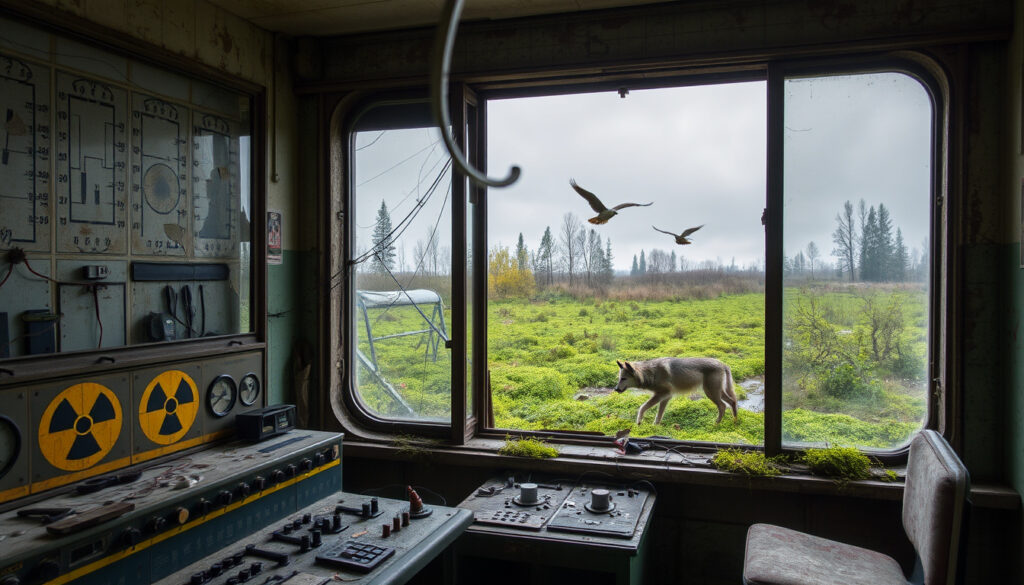
Chernobyl Nuclear Power Plant: Disaster, Radioactivity & Wildlife
When a safety experiment went wrong on a quiet April night in 1986, the Chernobyl nuclear power plant became the site of the world’s worst nuclear accident, destroying reactor 4 and sending a radioactive plume across Europe that forced tens of thousands from their homes. Decades later, the disaster still shapes how we think about nuclear safety—and how nature reclaims a landscape we abandoned.
Immediate deaths: 31 · Estimated long-term cancer deaths: 4,000–9,000 · Reactor type: RBMK-1000 · Date of accident: April 26, 1986 · Exclusion zone area: Approximately 2,600 km²
Quick snapshot
- Reactor 4 exploded on April 26, 1986 during a power transient (World Nuclear Association (industry body))
- 134 workers and firefighters suffered acute radiation syndrome (Canadian Nuclear Safety Commission (regulator))
- 31 immediate deaths from explosions and radiation (U.S. Nuclear Regulatory Commission (federal agency))
- Accident: April 26, 1986 (World Nuclear Association)
- Fire burned for 10 days (Canadian Nuclear Safety Commission)
- New Safe Confinement installed in 2016 (World Nuclear Association)
- Decommissioning continues; 40th anniversary in 2026
- Exclusion zone remains off-limits for thousands of years
- Wildlife populations continue to be monitored for adaptation signals
Five key facts set the stage for understanding the disaster and its legacy.
| Label | Value |
|---|---|
| Location | Near Pripyat, Ukraine (formerly Soviet Union) |
| Operator in 1986 | Soviet Ministry of Energy |
| Reactor design | RBMK-1000 (graphite-moderated, water-cooled) |
| Accident time | 01:23 AM local time |
| Containment structure | New Safe Confinement (NSC), completed 2016 |
How many died from the Chernobyl disaster?
Immediate deaths from acute radiation syndrome
The initial steam explosion killed two plant workers outright, according to the Canadian Nuclear Safety Commission (federal regulator). In the weeks that followed, 134 people who were at the site or involved in the emergency response developed acute radiation sickness. Of those, 28 died within the first few months. The U.S. Nuclear Regulatory Commission puts the total immediate death toll at 31, including the two killed in the explosion plus 29 more from radiation or injuries.
Later cancer fatalities attributed to the accident
The long-term health toll is harder to pin down. The World Health Organization and the International Atomic Energy Agency project an additional 4,000 excess cancer deaths among the most exposed populations. Other estimates run as high as 9,000. The U.S. NRC notes that these figures include both emergency workers and residents of contaminated areas, and the true number may never be known because radiation-induced cancers are indistinguishable from naturally occurring ones.
The immediate death count is firmly established at 31, but the cancer toll remains a statistical estimate, not a verifiable body count.
The implication: the lower bound is settled, but the upper bound depends on assumptions about dose and latency that scientists continue to debate.
How long will Chernobyl still be radioactive?
Half-lives of key isotopes
Radioactivity fades at different rates for different elements. Cesium-137 and strontium-90, the primary contaminants in the exclusion zone, each have a half-life of about 30 years. That means they will remain hazardous for roughly 300 years—until they decay to negligible levels. Plutonium-239, which was also released in the explosion, has a half-life of 24,000 years, according to the U.S. NRC (federal regulator).
The Chernobyl exclusion zone today
The 30-kilometer zone around the plant is still heavily contaminated, especially in patches of forest and soil where cesium settled. The NRC makes clear that the area will remain unsafe for permanent human habitation for thousands of years because of long-lived plutonium isotopes. Some limited access is allowed for research and tourism, but only under strict monitoring.
The exclusion zone’s radioactivity is decaying, but the presence of plutonium means the land won’t be safe for reoccupation for millennia—longer than any recorded human history.
The pattern: two different time horizons—cesium decays in centuries, plutonium in tens of millennia—mean the zone’s danger is not uniform across isotopes.
What went wrong in Chernobyl?
Flawed RBMK reactor design
The RBMK-1000 reactor used at Chernobyl had a dangerous feature called a positive void coefficient: as water turned to steam, the reactor’s power increased instead of stabilizing. This design flaw made it unstable at low power levels. The World Nuclear Association (industry expert body) describes the reactor as inherently flawed. The control rods also had a critical problem—they were tipped with graphite, which initially increased the reaction when inserted, before boron could absorb neutrons.
Operator errors during the safety test
On the night of the accident, operators were running a safety test to see how long the turbine could supply power after a shutdown. They disabled several safety systems and lowered the reactor to a forbidden power level. When they pressed the scram button (EPS-5), the reactivity spike caused by the graphite tips triggered an uncontrolled power surge. The World Nuclear Association (industry body) explains that the combination of a flawed design and deliberate bypass of safety systems made the explosion inevitable.
The pattern: a design that amplified human mistakes, not just a case of “operator error.”
Is Chernobyl still the worst nuclear disaster?
Comparison with Fukushima Daiichi
Both Chernobyl and Fukushima (2011) are classified as Level 7 on the International Nuclear Event Scale—the highest severity. But the differences are stark. Chernobyl caused 31 immediate deaths from radiation and explosions; Fukushima had zero direct radiation fatalities, according to the U.S. NRC (federal regulator). Chernobyl released far more radioactive material, especially cesium and plutonium, and the contamination spread across Europe. Fukushima’s releases were largely contained over the ocean.
Comparison with Three Mile Island
The 1979 accident at Three Mile Island (Pennsylvania) was a partial meltdown that released very little radiation outside the plant. It is rated Level 5. No one died. The NRC notes that TMI had a containment building that held the radioactive material; Chernobyl had no such containment. The Soviet reactor was designed without the kind of concrete dome that modern plants rely on.
Three accidents, three different outcomes on the same scale.
| Metric | Chernobyl (1986) | Fukushima (2011) | Three Mile Island (1979) |
|---|---|---|---|
| INES level | 7 | 7 | 5 |
| Immediate radiation deaths | 31 | 0 | 0 |
| Containment structure | None | Partial (leaked) | Intact |
| Primary radioactive release | Cesium, plutonium across Europe | Mostly over ocean | Minimal off-site |
| Evacuation scale | ~335,000 total | ~154,000 | ~144,000 (advisory) |
Chernobyl remains the only nuclear disaster that killed people instantly from radiation. That stark difference has driven global safety reforms, including mandatory containment structures and independent regulatory oversight.
What this means: the absence of a containment building was the single design difference that turned a bad accident into a catastrophic one.
Are there still mutated animals in Chernobyl?
Visible mutations vs. genetic studies
Despite popular myths, there is no evidence of giant radioactive monsters in the exclusion zone. Some individual animals—birds, rodents—have shown physical deformities such as partial albinism or tumors, but they are not widespread. Genetic studies reveal elevated mutation rates in some populations, especially barn swallows and voles, as reported by researchers. The NRC notes that chronic exposure to low-level radiation can cause cellular damage, but the overall effect on population health is still debated.
Wildlife population recovery in the exclusion zone
Ironically, the absence of humans has allowed wildlife to flourish. Wolves, deer, lynx, and even brown bears have recolonized the zone. A 2015 study found that mammal populations in the exclusion zone are similar to those in uncontaminated nature reserves. Researchers from the World Nuclear Association have called the zone an unintended wilderness preserve.
The catch: radiation is harmful, but for many species, the removal of human activity has been a bigger ecological benefit than the cost of radiation exposure.
What was the timeline of the Chernobyl disaster?
- 1977: Plant begins operation (World Nuclear Association).
- April 26, 1986: Reactor 4 explodes during safety test (World Nuclear Association).
- April–May 1986: Evacuation of Pripyat and 30 km zone.
- 1986–1990: Construction of initial sarcophagus.
- 2000: Last reactor (Unit 3) shuts down.
- 2016: New Safe Confinement slid over reactor 4.
- 2026: 40th anniversary; decommissioning continues.
What is confirmed and what remains unclear?
Six facts are solid; six uncertainties persist.
Confirmed facts
- 31 people died from acute radiation syndrome or explosions (U.S. NRC)
- 134 workers suffered acute radiation sickness (Canadian Nuclear Safety Commission)
- The accident was caused by design flaws and operator errors (World Nuclear Association)
- Exclusion zone remains contaminated for thousands of years (U.S. NRC)
- About 115,000 people evacuated in 1986 (U.S. NRC)
- Fire burned for 10 days (Canadian Nuclear Safety Commission)
What’s still debated
- Exact number of future cancer deaths (4,000–9,000 range)
- Full genetic effects on wildlife long-term
- Ultimate fate of the elephant’s foot (corium)
- Whether chronic low-dose radiation accelerates adaptation in local species
- Precise timeline for safe reoccupation of the zone (millennia is a range, not a date)
- Long-term health consequences of secondary contamination (food chain, water systems)
Perspectives from experts
No evidence of a major public health impact attributable to radiation exposure.
UNSCEAR report (UN scientific committee)
The Chernobyl accident in 1986 was the result of a flawed reactor design that was operated with inadequately trained personnel.
World Nuclear Association (industry expert body)
The exclusion zone has become a unique preserve for animals, despite radiation levels.
Gennady Laptev (wildlife researcher)
Summary
The Chernobyl disaster was a perfect storm of flawed engineering, human error, and a safety culture that valued production over protection. It killed 31 people directly, forced a permanent evacuation of a huge area, and left a radioactive scar that will outlive any government that tried to manage it. Yet in the decades since, nature has quietly reclaimed the zone—proving that even the worst industrial catastrophe can become an unintended sanctuary. For Ukraine and the international nuclear community, the lesson is clear: design flaws and human error can combine catastrophically, and eternal vigilance is the only safeguard.
en.wikipedia.org, chernobylgallery.com, world-nuclear.org, oecd-nea.org
Frequently asked questions
Did anyone go to jail because of Chernobyl?
Yes. The plant’s director, the chief engineer, and several other officials were sentenced to prison terms of 10 years or more for violating safety rules. The trial took place in 1987–88.
Whose body is under reactor 4?
No body is buried under the reactor. The story that a worker’s remains are entombed in the corium is a myth. The bodies of the immediate victims were recovered and buried in sealed coffins.
Why can’t the elephant’s foot be removed?
The elephant’s foot is a mass of corium (melted fuel and concrete) that remains intensely radioactive. Any attempt to move it would expose workers to lethal doses of radiation. It is monitored remotely.
What is the future fate of the Chernobyl elephant’s foot?
It will remain in place inside the New Safe Confinement for centuries, slowly cooling and becoming less radioactive. Eventually, it may be possible to dismantle or further isolate it, but no plans exist yet.
Where is the Chernobyl nuclear power plant located?
It is near the abandoned city of Pripyat, about 100 km north of Kyiv, Ukraine. The site sits on the Pripyat River, a tributary of the Dnieper.
How many people were evacuated after the Chernobyl disaster?
About 115,000 people were evacuated from the 30 km exclusion zone in 1986, and an additional 220,000 from other contaminated areas in subsequent years, according to the U.S. NRC.
Can you visit the Chernobyl exclusion zone today?
Yes, organized tours are permitted. Visitors must follow strict safety protocols, including dosimeter checks and bans on touching surfaces. The zone remains an active research and monitoring area.
More related posts
 Junior Doctor Strike Dates – Confirmed 2023-2024 Timeline
 Chris Eubank vs Conor Benn – Fight Results and Rivalry Conclusion
 Chanel No. 5 Perfume: Scent, Age Suitability & Buying Guide
 Do I Have to Notify HMRC of Savings Interest? – UK Tax Rules Guide
 How Long to Boil Potatoes: Timings by Size & Method
 Cary Grant: Top Questions About His Life, Death, and Movies
 12 Weeks From Today: Date Calculator & Guide
 Pain in Lower Right Abdomen Near Hip Bone Female – Causes and Red Flags
